Tuesday, 13 March 2012

All Saints

Rollover to zoom
Image 1 of 4

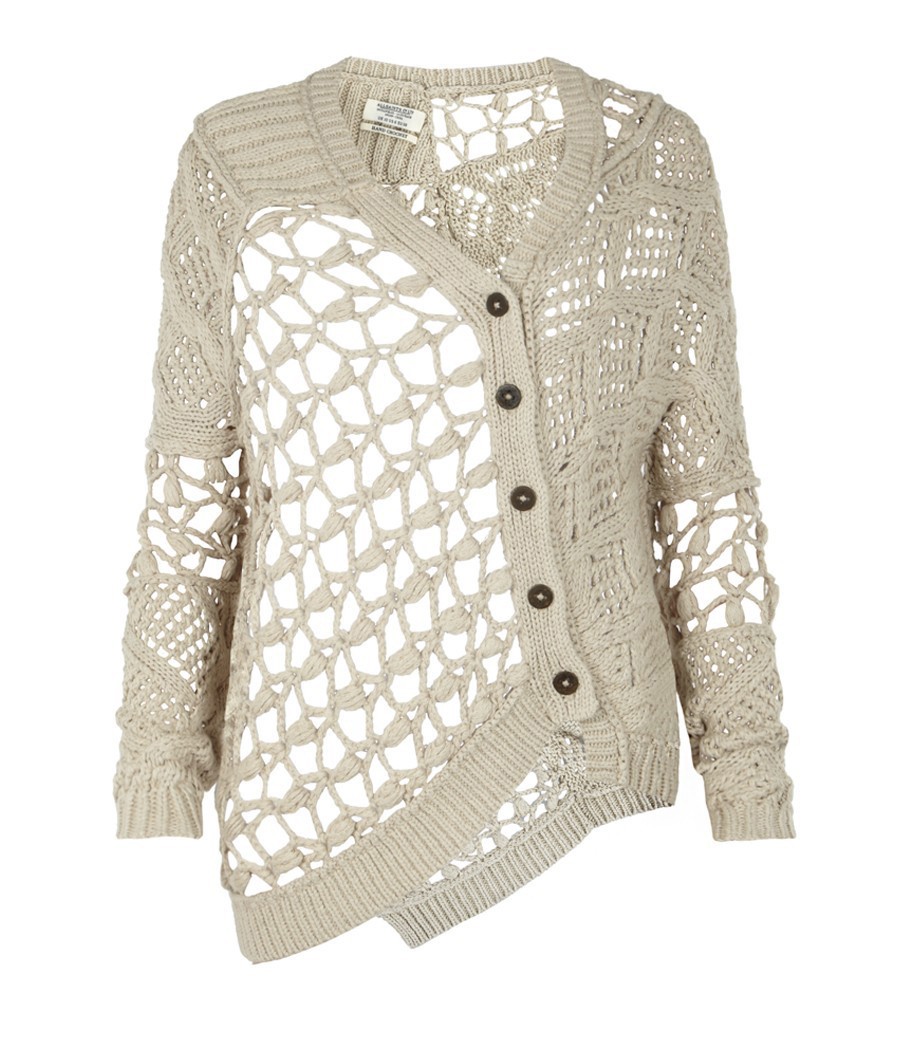
Summer Court Cardigan

£150.00
Colour 
Linen
Linen
Other colours 
Vintage Ebony
Cotton/linen deconstructed cardigan created on the stand using vintage jumpers. The Summer Court cardigan combines paneled and open work crochet with lace stitches and fastens along the asymmetric placket with signature dark rust metal buttons. A new take on an Aran cardigan.
Fabric 55% Linen 45% Cotton
Text taken from http://www.allsaints.com/women/knitwear/allsaints-summer-court-cardiga/?colour=940&category=26 (allsaints clothing website)
The idea of working with old clothing and getting new ideas, shapes and outcomes from them is somthing All Saints company does as well. I work for this company and we had a workshop explaing the new and invative techniques they used to create this seasons trends. Stated above by the company they used vintage jumpers and cardigans, cut them up and re-assembled them on mannequins to achieve these unique shapes.

MOSI - Museum Of Science and Industry

When visiting the archives in the MOSI there was a series of posters and advertisements ranging from the late 19th century onwards. Company's that would send products to non-English speaking countries would put these bright recognizable images on the products, shipments and in shop windows. Some have English, Arabic, or both languages on them while others just had images on them. This idea was very effective in that if someone was not able to read the language on the package to remember it for next time, they would just recognize the images and colours. This got me thinking that in the future with the possibility of many cultures coming together, and therefore many languages we may have to resort to this technique again. 

Swishing

This concept of sharing and exchanging clothes rather than going out and buying new ones has reminded me of an even hosted by a company called 'swishing' I had been to a few years ago. In which you bring unwanted items of clothing (in good condition) drop it off and they then proced to set up the items people have brought with them into a form of a modern shop. The idea is to bring a few pieces of clothing with you, and there for you can take the same number of pieces out with you.www.swishing.com

Sunday, 19 February 2012

Self Evalutaion of Project

1. Develop ideas creatively and imaginatively through research and sampling  Through out the unit I have explored many areas to gain inspiration for sampling, such as visiting to the zoo, aquarium, and library. All of the pictures (excluding the ones of the designers work) have been my own. The emphasis in colour in the project is something i have really enjoyed, this approach allowed me to look at images, yarns, and threads in a new light!     2. Respond to challenges and risk taking.   I think i could have been a bit more risk taking with my samples such as dying them (but i would have needed to get an induction to the dye lab). Other than that i experimented with washing my samples afterwards, weaving paper through them and mixing different types and qualities of yarns and threads, and experimenting with various weave structures.       3. Identify and apply appropriate methods of organisation and planning.   In the first part of the project with opposites i had not planned enough, with printing images out and working from them. Learning from my previous mistake, as soon as we started this project i printed all of my images out so i could see the true colours and textures which allowed me to work with the images while weaving. Something else i learnt was using white card to do the thread wraps on, in the first part of the project i used grey card which was very distracting from the true colour schemes i was working with. so in the second part i only used white card. Also doing drawings along side weaving gave me new ideas for patterns, colour schemes and threads to use.      4.Communicate effectively using a range of media.   through using different textured yarns and weave structures i think i was able to translate my ideas and images adequatly into representative samples. Having the images beside me, and drawings i produced before the samples or along side them (in the second half of the unit) really helped me convey my thoughts.  Being on the electric loom rather than a hand loom gave me the opportunity to explore a whole new range of structures and effects which you couldn't do on the hand loom. But starting on a hand loom introduced me to the potential outcomes of future samples.         5.Work independently in a safe manner, using appropriate health and safety procedures.   Once being inducted onto the looms (and especially second time round, having previous knowledge) I was confidante enough to try new techniques and go in alone to the weave room on a daily basis. Mind, the weave room is a very comfortable environment, knowing Rebecca (the weave technician) was there to help was very comforting. 

Ptential Display Samples

These three samples I am thinking ill out up for my display.
 I feel like they are the most complete samples, they also best represent the ideas I am trying to communicate.


Shelly Goldsmith Talk

Shelly Goldsmith- Fine Art - Instilation - Textiles
all in all very interesting to see a very different approach towards textiles......and was she ever DEEP !!! 

BDLE (best drawing lesson ever)

BDLE - best drawing lesson ever
This lesson was the one we had to make our own tools for drawing. I went a bit crazy at the pound shop and bought the most random things i could think of......curtain hooks, potato masher, shower hose, pegs, children's building blocks straws forks and combs.....were just some of them. I took huge enjoyment out of making the tools. The image below is off my tools!


My favourite one is made of lots of clothes pegs tapped together. It made beautiful thick lines when dragged but also gloppy marks when pressed on. I took a picture of the tool itself, even when its on its own and as an object it was interesting to look at, and the tool had characteristics of an image of coral in my book. 


These two images are of marks created by the tool.